
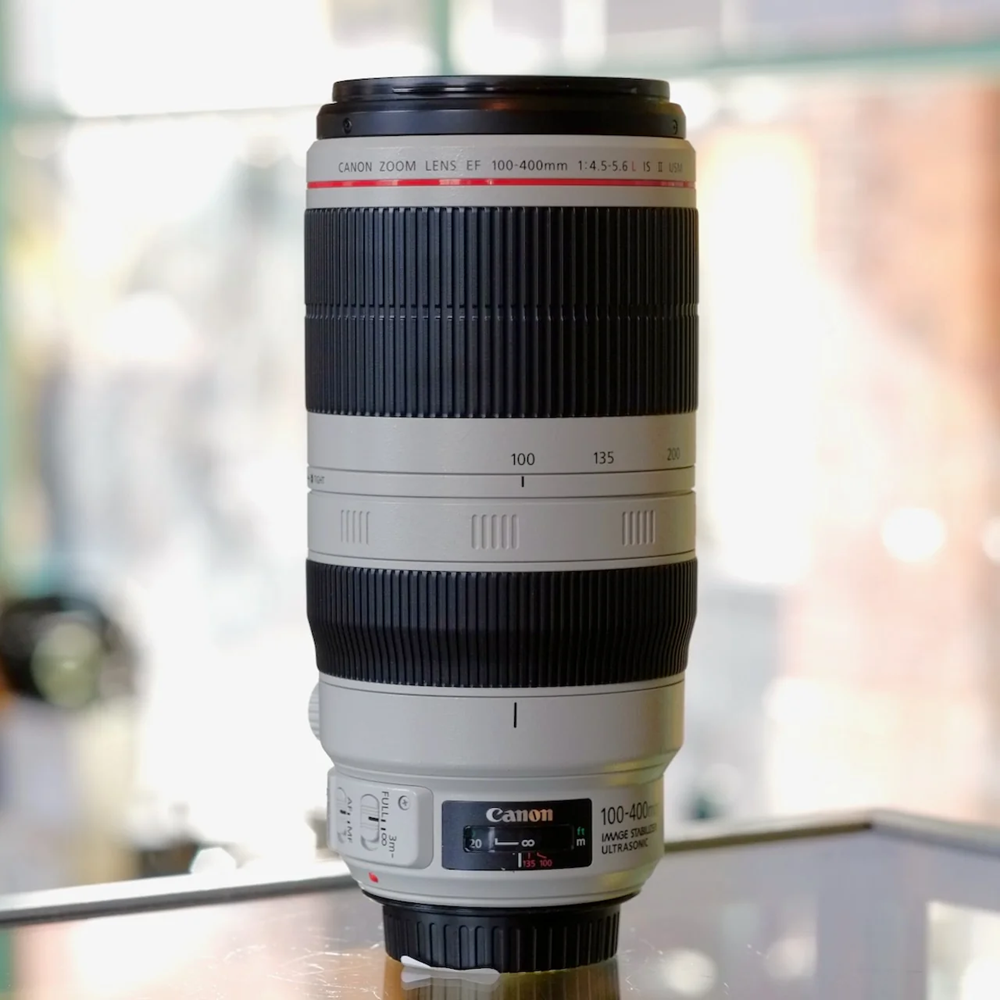
Canon EF 100-400mm f/4.5-5.6L IS II USM Rental & Hire in Kenya for Safari
Planning a Kenya safari and looking for a professional wildlife photography lens to rent? The Canon EF 100-400mm f/4.5-5.6L IS II USM remains a highly practical telephoto zoom for photographing wildlife across Kenya’s national parks, reserves and conservancies.
For tourists travelling to Kenya specifically for photography, the lens offers an excellent combination of reach, flexibility, image stabilization and Canon L-series optical performance. Its 100-400mm focal-length range is particularly useful for safari photography because wildlife encounters can change rapidly from one moment to the next.
Whether you are visiting the Masai Mara for the Great Migration, Amboseli to photograph elephants with Mount Kilimanjaro, Laikipia for rhinos and conservation photography, or Samburu for northern Kenya’s distinctive wildlife, a 100-400mm lens can provide a versatile telephoto solution without the size of a large professional super-telephoto prime.
If you are travelling to Kenya without your own long lens, renting the Canon EF 100-400mm locally from MaraZooms Safaris & Cameras Africa can be a convenient way to obtain dedicated wildlife photography equipment for your trip.
Why Rent the Canon EF 100-400mm for a Kenya Safari?
A safari is one of the situations where a telephoto zoom lens can be far more practical than carrying several fixed focal-length lenses.
Wildlife does not stay at a predictable distance.
An elephant can approach your safari vehicle. A lion may be lying some distance away. A cheetah can suddenly start running across the plains, while a leopard may be partially hidden in a tree.
The Canon EF 100-400mm allows you to react to these changing situations by simply adjusting the zoom.
At 100mm, you have a useful perspective for larger animals and environmental wildlife photographs.
At 200-300mm, you can create tighter compositions while retaining some of the surrounding landscape.
At 400mm, you gain substantially more reach for distant wildlife and detailed animal portraits.
This flexibility is one of the reasons the 100-400mm focal range has become so popular among wildlife photographers.
Canon EF 100-400mm for Masai Mara Wildlife Photography
For international tourists visiting Kenya primarily for wildlife photography, the Masai Mara is often the highlight of the trip.
The reserve offers exceptional opportunities to photograph lions, leopards, cheetahs, elephants, giraffes, zebras, wildebeest, buffalo and many other species.
The Canon EF 100-400mm is well suited to the Mara because much of the wildlife is encountered across relatively open terrain.
The 400mm end can help you fill the frame with a distant lion or cheetah without requiring the safari vehicle to approach unnecessarily closely.
When an animal comes closer, you can immediately zoom out.
That ability can be extremely useful when photographing wildlife from a safari vehicle where changing lenses is inconvenient.
Great Migration Photography
Tourists visiting the Masai Mara during the Great Migration can encounter enormous herds of wildebeest and zebra.
A long telephoto lens can be useful for isolating individual animals within these huge herds, while the 100mm end allows you to capture wider scenes showing the scale of the migration.
The lens can therefore handle both individual wildlife portraits and larger herd compositions.
For photographers photographing dramatic wildlife behaviour, the zoom range also makes it easier to maintain a suitable composition as animals move.
Canon EF 100-400mm for Amboseli Photography
Amboseli National Park is one of Kenya’s most recognizable wildlife destinations.
The park is famous for its elephants and spectacular views of Mount Kilimanjaro.
The Canon EF 100-400mm is particularly useful for photographers who want to photograph elephants both as individual subjects and as part of the surrounding landscape.
At 100mm, you can include more of the Amboseli plains and environmental surroundings.
At 400mm, you can create tighter elephant portraits and concentrate on details such as the animal’s face, ears and tusks.
This flexibility is particularly valuable when Mount Kilimanjaro is visible and you want to experiment with different compositions.
Canon EF 100-400mm for Laikipia Wildlife Photography
The Laikipia region is increasingly important for wildlife and conservation photography in Kenya.
Its conservancies provide opportunities to photograph rhinos, elephants, lions, leopards, giraffes, zebras and numerous other species.
The EF 100-400mm works particularly well for photographers who want a flexible lens for both wildlife and environmental images.
It can also be useful for conservation-focused photography where you may photograph animals, landscapes, rangers, guides and field activities during the same trip.
Wildlife Photography in Samburu, Tsavo and Lake Nakuru
The Canon EF 100-400mm is suitable for a wide variety of Kenyan safari destinations.
Samburu National Reserve
Samburu offers opportunities to photograph distinctive northern Kenya species, including Grevy’s zebra, gerenuk, reticulated giraffe and Beisa oryx, alongside elephants and big cats.
The 400mm reach can be valuable when photographing wildlife across the reserve.
Tsavo East and Tsavo West
The vast landscapes of Tsavo can produce excellent environmental wildlife photographs.
The 100-400mm range lets you switch between wider compositions and tighter wildlife portraits without changing lenses.
Lake Nakuru National Park
Lake Nakuru provides opportunities for rhinos, giraffes, buffalo, lions and many bird species.
The 400mm end can provide useful reach for wildlife, while photographers specializing in smaller birds may prefer an even longer lens.
Canon L-Series Optical Performance
The Canon EF 100-400mm f/4.5-5.6L IS II USM is part of Canon’s professional L-series.
It was designed to provide high optical performance across the zoom range, making it a serious wildlife photography lens rather than simply a general-purpose telephoto.
For tourists who have travelled thousands of kilometres to photograph Kenya’s wildlife, having a dedicated L-series telephoto lens can make a significant difference compared with relying on a standard kit lens.
Image Stabilization for Safari Photography
The lens features optical image stabilization, which can be particularly useful when photographing handheld from a safari vehicle.
Safari vehicles are not always perfectly stationary. You may be photographing while the engine is running, while other vehicles are moving nearby or while the vehicle is positioned on uneven ground.
Image stabilization can help reduce camera shake and make handheld shooting more practical.
It is especially useful at the 400mm end of the zoom range.
Autofocus for Moving Wildlife
The EF 100-400mm II uses Canon’s USM autofocus system, providing fast and responsive focusing for wildlife photography.
This can be useful when photographing animals walking toward your vehicle, running across the grasslands or interacting with other animals.
For photographers using compatible Canon DSLR bodies, it remains a capable wildlife photography combination.
The lens can also be used on Canon RF mirrorless cameras with the appropriate Canon EF-EOS R mount adapter.
Canon EF 100-400mm on a Canon DSLR
The lens is an EF-mount lens and can be paired with Canon DSLR cameras such as:
- Canon EOS 80D
- Canon EOS 90D
- Canon EOS 7D-series cameras
- Canon EOS 5D-series cameras
- Canon EOS 6D-series cameras
- Other compatible Canon EF DSLR bodies
For tourists who already own an older Canon DSLR, renting the EF 100-400mm can be an especially convenient way to upgrade their safari setup without purchasing a new camera system.
Canon EF 100-400mm With Canon EOS R Cameras
Photographers using Canon’s mirrorless EOS R system can also use the EF 100-400mm II with a compatible Canon EF-EOS R adapter.
This can be particularly useful for international tourists who own an EOS R camera but want access to a professional EF telephoto lens during their Kenya safari.
It can also provide a more affordable way to build a long-reach safari kit compared with purchasing a native RF L-series super-telephoto lens.
Is 400mm Enough for a Kenya Safari?
For many large wildlife encounters, yes.
A 400mm maximum focal length provides useful reach for lions, elephants, giraffes, cheetahs, zebras and other large animals.
However, photographers who specialize in birds or extremely distant wildlife may benefit from 500mm, 600mm or 800mm lenses.
This is why the EF 100-400mm is best viewed as a versatile all-round safari telephoto lens rather than an extreme-reach wildlife lens.
Its major advantage is the ability to move from 100mm to 400mm depending on the situation.
Canon EF 100-400mm vs RF 100-500mm
Photographers using Canon’s RF system may also consider the RF 100-500mm.
The RF 100-500mm provides an additional 100mm of reach and is a native RF-mount L-series lens.
However, the EF 100-400mm II remains an attractive rental option because it can be used with Canon DSLR cameras and adapted to Canon RF bodies.
For tourists who already own compatible EF equipment, renting the EF version can also be a cost-effective way to obtain a serious wildlife lens for a Kenya trip.
Canon EF 100-400mm vs RF 200-800mm
The RF 200-800mm is designed for photographers who prioritize maximum reach.
Its 800mm focal length provides considerably more reach than the EF 100-400mm.
However, the EF lens starts at 100mm, which makes it considerably more flexible for close wildlife and environmental compositions.
For a tourist who wants one versatile lens for general safari photography, the 100-400mm remains highly practical.
For a photographer whose priority is distant wildlife and birds, the 200-800mm is likely to be more suitable.
Why Tourists Should Rent a Wildlife Lens in Kenya
International safari tourists often face a difficult choice when preparing for a Kenya trip.
Buying a professional wildlife lens can be expensive, particularly if you only plan to use it for one safari.
Carrying large camera equipment through international airports can also add weight and complexity to your journey.
Renting a wildlife lens in Kenya provides another option.
Instead of purchasing a lens specifically for your holiday, you can arrange a suitable telephoto lens before arriving and use it throughout your safari.
This is particularly attractive for tourists travelling from the United States, United Kingdom, Canada, Australia, Europe, Asia and other international markets.
Hotel Delivery in Nairobi Kenya
MaraZooms Safaris & Cameras Africa is designed around the needs of photographers travelling to Kenya.
Depending on your itinerary, camera and lens rental equipment can be arranged for hotel, lodge or other agreed delivery locations in Kenya.
This can be particularly convenient for international tourists who do not want to travel across Nairobi looking for camera equipment after arriving in the country.
For example, your equipment can be arranged around your travel itinerary, allowing you to receive your rental equipment before heading toward the Masai Mara, Amboseli, Laikipia or another safari destination.
For photographers staying at a safari lodge, delivery and collection arrangements can also make the rental process significantly easier.
Airport Pickup, Hotel Collection and Equipment Returns
Tourists arriving in Kenya may also prefer to arrange equipment pickup around their arrival and departure schedule.
Depending on the rental arrangement, MaraZooms can coordinate equipment delivery and collection around your Kenya itinerary.
This means your safari lens rental can be planned around your hotel stay, safari lodge or other agreed collection point.
The goal is simple: you should spend your time photographing wildlife rather than searching for photography equipment.
Who Should Rent the Canon EF 100-400mm?
The lens is particularly suitable for:
- International safari tourists
- Wildlife photography enthusiasts
- Beginner wildlife photographers
- Canon DSLR owners
- Canon EOS R users with an EF adapter
- Masai Mara visitors
- Great Migration photographers
- Amboseli elephant photographers
- Laikipia wildlife photographers
- Travel photographers
- Nature photographers
- Photographers looking for a versatile 100-400mm rental
Book the Canon EF 100-400mm for Your Kenya Safari
The Canon EF 100-400mm f/4.5-5.6L IS II USM remains an excellent choice for photographers looking for a versatile wildlife lens for a Kenya safari.
Its combination of 100-400mm reach, L-series optical performance, image stabilization and flexible zoom range makes it particularly useful for photographing the unpredictable wildlife encounters that make Kenya such a popular safari destination.
Use it to photograph lions and cheetahs in the Masai Mara, elephants and Mount Kilimanjaro in Amboseli, rhinos and conservation wildlife in Laikipia, distinctive northern species in Samburu, or elephants and expansive landscapes in Tsavo.
For international tourists, renting locally can also make the trip easier. Arrange your camera equipment around your itinerary with hotel, safari lodge or agreed collection and return options, rather than carrying a professional telephoto lens from home.
Planning a Kenya safari? Rent the Canon EF 100-400mm f/4.5-5.6L IS II USM from MaraZooms Safaris & Cameras Africa and take a professional wildlife photography lens with you into the Kenyan wilderness.

Reviews
There are no reviews yet.