Is the Sony A7 IV + 200-600mm a Good Safari Combo?
Masai Mara, Amboseli & Other Kenya Wildlife Safaris
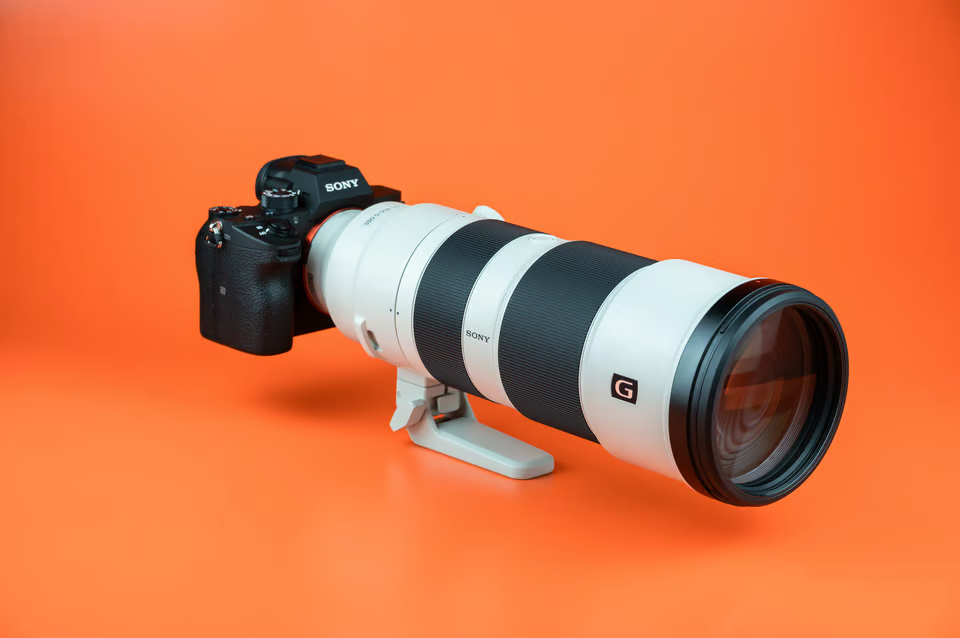
If you are planning a wildlife photography safari in Kenya and want a camera setup capable of producing sharp, detailed photographs of lions, elephants, leopards, cheetahs, giraffes and birds, the Sony A7 IV paired with the Sony FE 200-600mm F5.6-6.3 G OSS is one of the combinations worth considering.
But is it actually a good safari combination?
Yes. The Sony A7 IV + 200-600mm is an excellent all-round full-frame safari setup.
The combination brings together a 33-megapixel full-frame camera with advanced autofocus, animal and bird tracking, 10 fps continuous shooting and in-body stabilization, with a 200-600mm G-series super-telephoto lens designed specifically for subjects such as wildlife and sports. Sony lists the A7 IV with a 33MP full-frame sensor, up to 10 fps continuous shooting and 759 phase-detection AF points, while the 200-600mm provides a 200-600mm range, optical stabilization and compatibility with Sony’s 1.4x and 2x teleconverters.
For a safari in the Masai Mara, Amboseli, Tsavo, Lake Nakuru or other Kenyan wildlife destinations, it is a particularly strong combination because it gives you both image quality and substantial reach without requiring a collection of large prime lenses.
Sony A7 IV + 200-600mm: Quick Overview
| Feature | Sony A7 IV + 200-600mm |
|---|---|
| Camera | Sony A7 IV |
| Sensor | 33MP full-frame |
| Lens | Sony FE 200-600mm F5.6-6.3 G OSS |
| Focal range | 200-600mm |
| APS-C equivalent | 300-900mm |
| Continuous shooting | Up to 10 fps |
| Autofocus | 759 phase-detection points |
| Animal Eye AF | Yes |
| Bird Eye AF | Yes |
| Camera stabilization | 5-axis IBIS |
| Lens stabilization | Optical SteadyShot |
| Lens weight | 2,115g |
| Minimum focus distance | 2.4m |
| Teleconverter support | 1.4x and 2x |
| Best use | Wildlife, birds and safari photography |
Sony describes the A7 IV as a 33MP full-frame camera with AI-powered autofocus, Real-time Tracking and Eye AF for animals and birds. It can shoot at up to 10 fps in Hi+ mode.
The 200-600mm weighs approximately 2,115g, has a 2.4m minimum focusing distance and provides optical image stabilization.
Why the Sony A7 IV + 200-600mm Works So Well for Safari
The strength of this combination is that neither component is a compromise.
The A7 IV provides a high-resolution full-frame sensor and modern autofocus, while the 200-600mm provides the long reach needed for wildlife.
You essentially have a setup capable of going from:
200mm → 300mm → 400mm → 500mm → 600mm
without changing lenses.
That is extremely useful inside a safari vehicle.
An animal may be far away one moment and significantly closer a few minutes later.
Instead of changing lenses, you simply zoom.
Is 600mm Enough for a Kenya Safari?
For most safari photographers, yes.
In fact, 600mm is an excellent focal length for African wildlife.
At 600mm, you can photograph:
- Leopards
- Lions
- Cheetahs
- Elephants
- Giraffes
- Rhinos
- Zebras
- Wildebeest
- Birds
- Smaller mammals
- Wildlife portraits
The 200-600mm can be particularly useful when animals are far from the vehicle.
You cannot always ask your safari driver to move closer.
There may be other vehicles, difficult terrain, vegetation, rivers or simply an animal that doesn’t want to approach.
Having 600mm available allows you to make better use of distant encounters.
Is 200mm Wide Enough for Safari?
This is one of the most important questions when considering the Sony 200-600mm.
The answer is:
Usually, yes for wildlife, but not always.
A 200mm lens is still quite long.
If an elephant walks directly toward your vehicle, 200mm may be too tight to photograph the entire animal.
The same can happen with:
- Giraffes
- Large groups of animals
- Buffalo
- Very close lions
- Elephants
- Animals approaching the vehicle
This is the main limitation of the combination.
The 200-600mm is primarily a wildlife telephoto setup, not a complete safari photography kit.
If you want landscapes, lodge photography and environmental scenes, consider adding a shorter lens such as a 24-70mm or 24-105mm.
Sony A7 IV + 200-600mm for the Masai Mara
The Masai Mara is arguably one of the best places to use this combination.
The open landscape and abundance of wildlife create many opportunities where a long telephoto is useful.
You can photograph:
- Lions
- Leopards
- Cheetahs
- Elephants
- Wildebeest
- Zebras
- Giraffes
- Buffalo
- Birds of prey
- Other wildlife
For lions
The 200-600mm gives you plenty of flexibility.
At 200-300mm, you can photograph larger scenes and groups.
At 400-600mm, you can isolate individual lions.
For a resting lion several hundred metres away, 600mm can be extremely useful.
For leopards
This is one of the strongest use cases.
Leopards may be:
- In trees
- Across open grassland
- Partially hidden in vegetation
- Near rivers
- Relatively far from the vehicle
The 600mm end gives you considerably more reach for these encounters.
For cheetahs
The same principle applies.
Cheetahs can be difficult to photograph at close range because they often operate across open areas.
The 200-600mm gives you the reach to capture them without requiring the vehicle to be extremely close.
Sony A7 IV + 200-600mm for the Great Migration
If you are visiting the Masai Mara during the Great Migration, this combination becomes even more interesting.
You can use different focal lengths for different types of photographs.
200mm
Useful for:
- Herds
- Environmental compositions
- Groups of wildebeest
- Animals within the landscape
400mm
Useful for:
- Individual animals
- Groups at medium distance
- Wildlife action
600mm
Useful for:
- Individual wildebeest
- River crossings
- Predators
- Distant action
- Wildlife portraits
The flexibility of a zoom is particularly valuable during unpredictable migration events.
Sony A7 IV + 200-600mm for Amboseli
Amboseli National Park is another excellent destination for this setup.
The park is famous for its elephants and spectacular views toward Mount Kilimanjaro.
The 200-600mm gives you the ability to photograph elephants at different distances.
For example:
200mm: elephant within its environment
300-400mm: individual elephant or small group
600mm: detailed elephant portrait
This makes the combination excellent for wildlife.
However, if your primary goal is to photograph:
Elephants with Mount Kilimanjaro
you may want to carry a shorter lens as well.
A 24-105mm or 24-70mm would give you a much wider perspective for environmental landscapes.
Sony A7 IV + 200-600mm for Tsavo
The combination is also highly capable for Tsavo National Park.
Tsavo offers opportunities to photograph:
- Elephants
- Lions
- Giraffes
- Buffalo
- Birds
- Other wildlife
Because wildlife encounters can occur at varying distances, the 200-600mm’s flexibility is valuable.
For a photographer travelling to Tsavo primarily to photograph wildlife, I would consider this an excellent single-telephoto setup.
Sony A7 IV + 200-600mm for Lake Nakuru
Lake Nakuru is particularly interesting for photographers because of its birdlife as well as larger mammals.
The 600mm end can be useful for:
- Birds
- Flamingos
- Eagles
- Rhinos
- Giraffes
- Other wildlife
The A7 IV’s animal and bird autofocus capabilities are also useful when photographing moving subjects. Sony specifies Real-time Eye AF and Real-time Tracking for animals and birds.
Is the Sony A7 IV Good for Wildlife Photography?
Yes.
The A7 IV isn’t marketed exclusively as a wildlife camera, but it has many characteristics that make it very capable for wildlife photography.
The 33MP full-frame sensor gives you plenty of resolution for cropping.
That matters because wildlife doesn’t always fill the frame.
You may capture an animal at 600mm and still want to crop the image later.
Having 33 megapixels gives you more flexibility than a lower-resolution sensor.
Sony lists the A7 IV’s still resolution at approximately 33MP and its maximum image size at 7008 × 4672 pixels.
Is the A7 IV Autofocus Good Enough for Safari?
Yes.
The A7 IV uses a Fast Hybrid AF system with 759 phase-detection AF points, covering roughly 94% of the image area, and supports Real-time Tracking and Eye AF for animals and birds.
This is particularly useful for wildlife because animals rarely stay still.
You may be photographing:
- A running cheetah
- A walking lion
- A flying bird
- Fighting animals
- A moving elephant
- Wildebeest crossing a river
Tracking autofocus can help maintain focus on the subject while you concentrate on composition.
However, autofocus isn’t magic.
Branches, grass and other animals can still confuse the system.
Good technique and appropriate AF settings remain important.
Is 10 FPS Enough for Wildlife Photography?
Yes.
The A7 IV can shoot at up to 10 frames per second in Hi+ mode, with AF/AE tracking, although the maximum rate depends on settings and file format.
Ten frames per second is enough for most safari photography.
For example, if a lion jumps or a bird takes off, you can capture a sequence of photographs rather than relying on a single frame.
For most safari photographers, 10 fps is more than adequate.
You don’t necessarily need a 20, 30 or 40 fps camera to get excellent wildlife photographs.
Is 33MP Too Much for Safari?
No.
In fact, I think 33MP is a very useful resolution for safari photography.
One of the biggest challenges with wildlife photography is distance.
You may not always fill the frame.
A higher-resolution sensor gives you more flexibility to crop.
For example, if a leopard is sitting far away, you can crop into the photograph while retaining useful detail.
This doesn’t mean more megapixels automatically produce better wildlife images.
Lens quality, light, focus accuracy, shutter speed and technique remain extremely important.
But the A7 IV’s 33MP resolution is a very good balance.
What About Low-Light Safari Photography?
This is one area where the combination is good but not perfect.
The Sony 200-600mm has a maximum aperture of:
f/5.6 at 200mm
and:
f/6.3 at 600mm.
That is typical for a long wildlife zoom, but it isn’t a fast lens.
Early morning and late afternoon can therefore require higher ISO settings.
Fortunately, the A7 IV’s full-frame sensor gives you useful flexibility in low light, with a native ISO range of 100-51,200.
The important thing is not to sacrifice shutter speed simply to keep ISO low.
For moving wildlife, a sharp high-ISO photograph is generally better than a blurry low-ISO photograph.
Recommended Safari Settings for Sony A7 IV + 200-600mm
There is no single setting that works for every wildlife encounter, but a useful starting point is:
For stationary wildlife
Shutter: 1/1000 sec
Aperture: f/6.3-f/8
ISO: Auto ISO
AF: AF-C
Subject recognition: Animal
For moving wildlife
Shutter: 1/1600-1/2500 sec
Aperture: f/6.3
ISO: Auto ISO
AF: AF-C
Drive: Continuous shooting
For birds in flight
Shutter: 1/2000 sec or faster
Aperture: f/6.3-f/8
ISO: Auto ISO
AF: AF-C
Drive: Continuous shooting
These are starting points rather than rigid rules.
You should adjust them depending on light, subject speed and the effect you want.
Should You Use 600mm All the Time?
No.
One of the mistakes beginners make with a 200-600mm lens is thinking they should leave it at 600mm constantly.
You should use the focal length that gives you the best composition.
For example:
200mm: large animal close to vehicle
300mm: animal with some surroundings
400mm: individual animal
500mm: tighter composition
600mm: distant wildlife or close portrait
The strength of the lens is not simply that it reaches 600mm.
It is that you have 200-600mm available without changing lenses.
Is the 200-600mm Too Heavy for Safari?
The lens weighs approximately 2,115g.
Add the A7 IV body, battery, memory card and accessories, and you have a substantial camera setup.
But there is an important distinction between carrying it around all day and using it from a safari vehicle.
Inside a safari vehicle, the weight is much less of a problem because you can support the lens on:
- A bean bag
- Your lap
- A vehicle support
- Your hands while bracing against the vehicle
The lens also uses an internal zoom mechanism, so its physical length does not change when you zoom from 200mm to 600mm. Sony says this helps maintain consistent balance while shooting.
Does the 200-600mm Have Image Stabilization?
Yes.
The lens features Optical SteadyShot.
Sony provides three stabilization modes, including a mode intended to make framing erratic wildlife and sports movement easier.
The A7 IV also has 5-axis in-body image stabilization rated by Sony at up to 5.5 stops for stills.
This combination can make handheld shooting considerably easier.
However, remember:
Image stabilization helps compensate for camera movement.
It does not freeze a moving animal.
If a cheetah is running, you still need a sufficiently fast shutter speed.
Is the 200-600mm Weather Resistant Enough for Kenya Safari?
The lens has a dust and moisture-resistant design, according to Sony.
That’s useful for safari conditions where you may encounter:
- Dust
- Light rain
- Mud
- Humidity
- Changing temperatures
But weather resistance does not mean you should deliberately expose the equipment to heavy rain or dust.
Safari environments can be extremely dusty.
I would still recommend:
- Keeping the camera covered when not shooting
- Avoiding unnecessary lens changes
- Carrying a blower
- Carrying microfiber cloths
- Keeping equipment inside a bag when not in use
- Cleaning the exterior regularly
What About Dust Inside the Lens?
One of the advantages of the 200-600mm for safari is that it uses an internal zoom mechanism.
The lens does not physically extend when you zoom.
Sony specifically highlights this design as helping maintain balance and preventing the front element from changing position relative to the subject while zooming.
This does not make the lens immune to dust, but it is a useful design characteristic for a safari environment.
I would still treat dust protection seriously.
Should You Take a Second Camera Body?
If photography is extremely important to you, yes.
For a casual traveller, one A7 IV may be enough.
For a serious wildlife photographer, a second body provides several advantages.
For example:
A7 IV + 200-600mm
and:
Second camera + 24-70mm or 24-105mm
This gives you a long telephoto setup and a general-purpose camera without constantly changing lenses.
It also provides redundancy.
If one camera develops a problem, you still have another body.
Is the A7 IV + 200-600mm Better Than the A7 III + 200-600mm?
Both are excellent combinations.
However, the A7 IV is the more modern and capable body.
The A7 IV provides:
- 33MP vs 24.2MP
- Newer BIONZ XR processing
- More advanced autofocus
- Animal and bird Eye AF
- 759 phase-detection AF points
- Up to 10 fps
- Improved video capabilities
Sony describes the A7 IV as having a 33MP sensor and AI-powered autofocus, while its specifications include 759 phase-detection points and up to 10 fps continuous shooting.
The A7 III remains a very capable safari camera, particularly when paired with the 200-600mm.
But if you’re choosing a body specifically for a premium safari rental package, I would favor the A7 IV.
Is the A7 IV + 200-600mm Good for a Beginner?
Yes, with one qualification.
The equipment is capable enough for a beginner, but the photographer still needs to learn how to use it.
The 200-600mm is a serious telephoto lens.
At 600mm, small movements become magnified.
A beginner should spend some time practising before the safari.
Practice:
- Finding subjects quickly
- Zooming while tracking
- Using AF-C
- Using animal Eye AF
- Adjusting shutter speed
- Managing Auto ISO
- Holding the lens properly
- Shooting through a vehicle window
- Using a bean bag
That preparation can make a huge difference.
What Is the Best Camera Setup for a Kenya Safari?
If I were building a simple but serious setup around the A7 IV, I’d consider:
Main wildlife setup
Sony A7 IV + Sony 200-600mm
This would handle the majority of wildlife encounters.
General-purpose setup
Sony A7 IV or second body + 24-70mm/24-105mm
For:
- Landscapes
- People
- Camps
- Mount Kilimanjaro
- Environmental scenes
- Safari vehicles
- Lodge photography
Optional second telephoto
If birds and distant wildlife are a major priority, a longer specialist lens can also make sense.
But for most safari tourists, the A7 IV + 200-600mm is already a very strong starting point.
Who Should Choose the Sony A7 IV + 200-600mm?
This combination is particularly well suited to photographers who:
- Are visiting Kenya primarily for wildlife
- Want a full-frame camera
- Want significant telephoto reach
- Photograph lions and leopards
- Photograph birds
- Want to photograph the Great Migration
- Want to crop wildlife photographs
- Want modern autofocus
- Want one serious wildlife lens
- Don’t want to change lenses frequently
Who Might Want Something Different?
The combination isn’t perfect for every safari traveller.
You might choose a different setup if:
You want a lightweight setup
The 200-600mm is substantial.
A smaller 100-400mm or 150-500mm may be more comfortable.
You want landscapes
You’ll probably want a second shorter lens.
You mainly photograph close elephants
A shorter zoom can sometimes be more useful.
You primarily photograph birds
The 200-600mm is excellent, but an 800mm-class lens may provide even more reach.
You want professional low-light wildlife photography
A fast prime such as a 300mm f/2.8 or 400mm f/2.8 offers capabilities the 200-600mm cannot match, although at much greater cost, size and weight.
Final Verdict: Is the Sony A7 IV + 200-600mm a Good Safari Combo?
Yes. It is one of the best all-round Sony setups for a Kenya wildlife safari.
The Sony A7 IV + 200-600mm combines a high-resolution 33MP full-frame body with a serious 600mm wildlife zoom.
The camera gives you:
- High resolution
- Excellent autofocus
- Animal and bird tracking
- 10 fps continuous shooting
- Full-frame image quality
- Strong cropping flexibility
- In-body stabilization
The lens gives you:
- 200-600mm reach
- Optical stabilization
- Fast and precise autofocus
- Internal zoom
- Wildlife-oriented stabilization
- Dust and moisture-resistant design
- 1.4x and 2x teleconverter compatibility
Sony’s official specifications confirm the lens’s 200-600mm range, 2,115g weight, 2.4m minimum focus distance, optical stabilization and teleconverter compatibility.
For Kenya, I would rate the combination:
| Safari requirement | A7 IV + 200-600mm |
|---|---|
| Masai Mara | ★★★★★ |
| Great Migration | ★★★★★ |
| Amboseli wildlife | ★★★★★ |
| Tsavo | ★★★★★ |
| Lake Nakuru | ★★★★★ |
| Lions | ★★★★★ |
| Leopards | ★★★★★ |
| Cheetahs | ★★★★★ |
| Elephants | ★★★★★ |
| Birds | ★★★★★ |
| Wildlife portraits | ★★★★★ |
| Distant wildlife | ★★★★★ |
| Environmental landscapes | ★★★ |
| Close wildlife | ★★★★ |
| Portability | ★★★★ |
| Overall safari capability | ★★★★★ |
The bottom line
If someone told me:
“I am going to Kenya for a wildlife safari and I want one serious Sony camera and telephoto lens combination.”
The Sony A7 IV + 200-600mm would be one of my first recommendations.
For the Masai Mara, it gives you the reach needed for predators and distant wildlife.
For Amboseli, it gives you excellent reach for elephants.
For Tsavo, it gives you flexibility when wildlife is distant.
For Lake Nakuru, it gives you the reach needed for both mammals and birds.
And for the Great Migration, the combination gives you a useful 200-600mm range for everything from wider herd compositions to distant wildlife action.
The only major limitation is that 200mm is not particularly wide for a safari. If you want landscapes, camps, people and environmental photographs, add a shorter lens rather than expecting the 200-600mm to do everything.
Should You Rent the Sony A7 IV + 200-600mm for Your Kenya Safari?
For an international visitor coming to Kenya specifically for wildlife photography, renting the Sony A7 IV + 200-600mm can be an attractive alternative to buying the equipment.
You can use the same setup throughout a safari covering destinations such as:
Nairobi → Masai Mara → Amboseli → Tsavo → Lake Nakuru
depending on your itinerary.
For photographers who already own a Sony camera, another option is to bring your own body and rent only the Sony 200-600mm lens.
That can be particularly useful if your existing Sony body is compatible with the lens but you don’t want to travel internationally with a large telephoto.
MaraZooms Safaris & Cameras Africa offers safari camera and wildlife lens rental options for photographers travelling through Kenya, with equipment suitable for destinations including the Masai Mara, Amboseli, Tsavo and other wildlife destinations.
Related MaraZooms Guides
- Sony A7 III + 200-600mm for Kenya Safari
- Sony 200-600mm vs Sony 100-400mm for Safari
- Sony 200-600mm vs Tamron 150-500mm for Safari
- Sony 200-600mm vs Sony 400-800mm for Wildlife Safari
- Best Sony Camera and Lens Combination for a Kenya Safari
- Best Lens for Masai Mara Wildlife Photography
- Best Camera and Lens for the Great Migration
- Best Lens for Amboseli Elephant Photography
- Best Camera Equipment for a Kenya Safari
- Should You Rent or Buy a Telephoto Lens for an African Safari?
